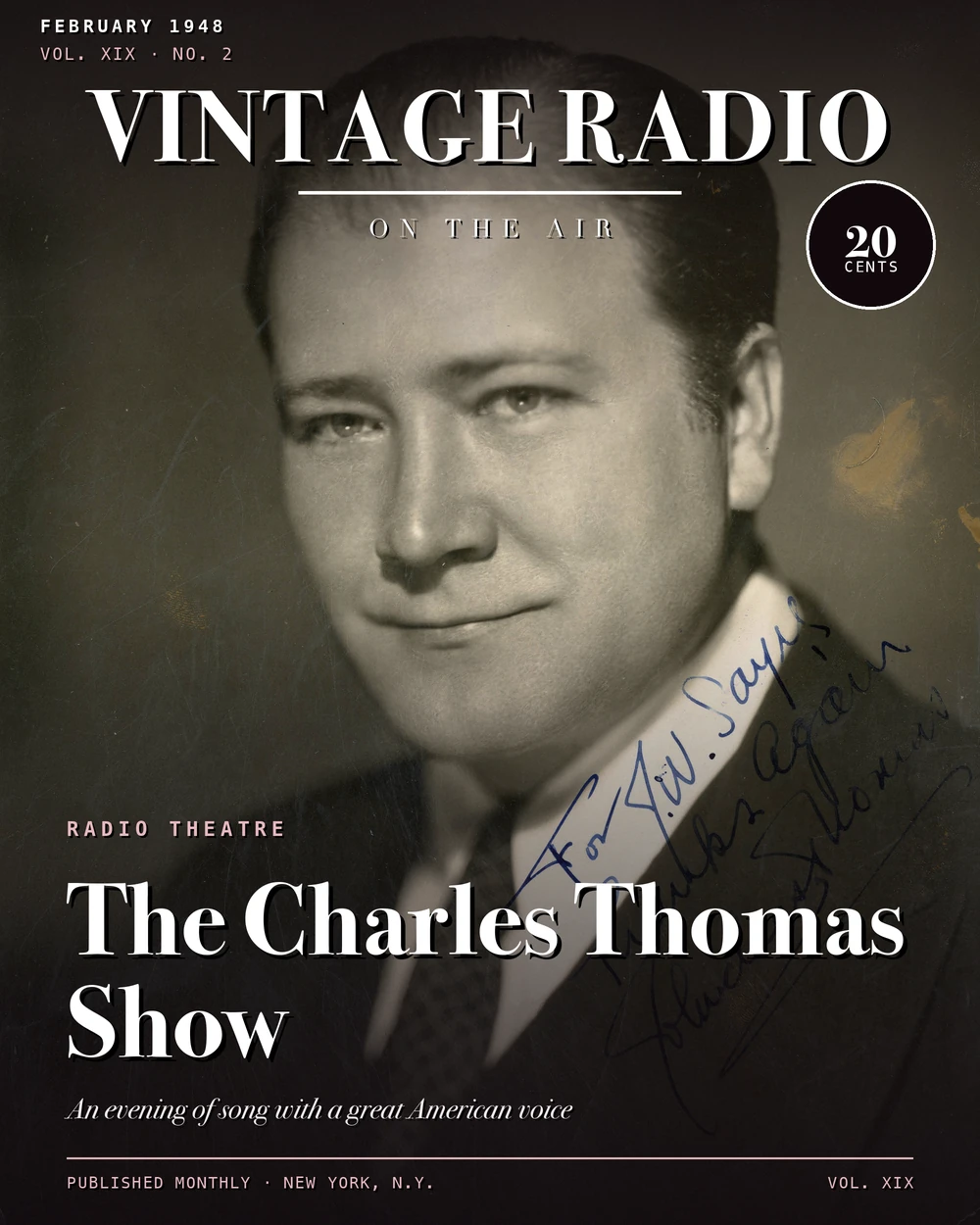
The Charles Thomas Show
The Man Behind the Microphone
John Charles Thomas had one of the genuinely remarkable voices in American music — Opera News critic Frank Chapman ranked him among the four greatest voices he had ever heard, placing him alongside Enrico Caruso, Rosa Ponselle, and Ezio Pinza. He had earned that company honestly. Born on September 6, 1891, in Meyersdale, Pennsylvania, the son of a Methodist minister of Welsh descent and a mother of German immigrant stock who had been an amateur singer herself, Thomas started on an unlikely path: he was studying medicine before winning a scholarship to the Peabody Institute in Baltimore in 1910, where he trained under voice teacher Adelin Fermin. What followed was a career that moved through Broadway, the concert hall, the recording studio, and finally the airwaves.
He left the Peabody in 1912, signed with the Shubert brothers, and spent the next nine years starring in Broadway musicals — Her Soldier Boy, Maytime, Naughty Marietta, and Apple Blossoms, the last of which featured a young Fred and Adele Astaire in the cast. That stage background shaped his voice in ways a purely classical training might not have: his top register was notably free and flexible, and what distinguished him most was an energy and expressiveness that connected as readily with a popular ballad as with a Verdi aria. He made his Metropolitan Opera debut on February 2, 1934, singing Elder Germont in La traviata, and remained at the Met until 1943, performing opposite soprano Rosa Ponselle, among others.
By the time he stepped away from the Met and into the Westinghouse engagement full-time, Thomas already had more than a decade of radio behind him. His broadcast work included Five-Star Theater in 1932–33 with the Joseph Bonime Orchestra, the Vince Radio Program from 1934 to 1936, The Magic Key of RCA on NBC from 1937 to 1940, the Ford and General Motors shows in the same period, and the Coca-Cola show from 1940 to 1941. He also recorded extensively — for Vocalion from 1920 to 1924, Brunswick Records from 1924 to 1929, and then RCA Victor starting in 1931. Radio was not new terrain for him. It was, increasingly, his main stage.
How the Westinghouse Program Came Together
The Charles Thomas Show — also known as The Westinghouse Program — launched on NBC on January 10, 1943, and ran every Sunday at 2:30 in the afternoon, each episode thirty minutes long. World War II had complicated life for concert performers: touring had become logistically difficult, and the tax environment made it financially unrewarding. Thomas accepted the Westinghouse engagement under those circumstances, and the sponsorship was a substantial one. OTR researcher Jim Ramsburg has documented that the show carried a weekly budget of $8,500 — real money for a radio hour of any kind, and an indication of how seriously Westinghouse treated the production.
The program opened with an orchestra led by Mark Warnow, a conductor then best known for his long run on CBS Radio's Your Hit Parade. (A 1941 newspaper profile had called Warnow "the busiest man in radio.") The chorus was directed by Lyn Murray, who had also worked alongside Warnow at Your Hit Parade. Both men were replaced in March 1943, just a few months into the run: Victor Young took over the orchestra, and Ken Darby stepped in to lead the chorus. Young and Darby would hold those roles for the remainder of the program's run. That pair — Young with his deep background as a composer, violinist, and arranger trained at the Warsaw Imperial Conservatory, and Darby leading his ensemble of singers — gave the show a musical foundation that matched Thomas's own reach, from popular song to light classical.
Clarence Olmstead produced the show throughout. Lee Sweetland served as Thomas's summer replacement in 1944, and announcer Gayne Whitman filled the narrator role during broadcasts. The format was consistent across its run: Thomas sang — popular songs, ballads, and light classical pieces — and the show opened each week with its signature theme, "Home on the Range," which Thomas delivered robustly.
The Theme Song and What It Meant
The choice of "Home on the Range" as the program's theme was not incidental. The version Thomas used was built on an arrangement by Texas composer David W. Guion, whose 1930 setting had essentially transformed the song from an obscure cowboy tune into a widely recognized American standard. It got an additional boost in national currency when President Franklin D. Roosevelt publicly named it his favorite song — a declaration that had preceded the Westinghouse program and given the song a kind of official American warmth. Thomas is credited as the singer who introduced "Home on the Range" to national radio audiences at scale, and biographer Michael J. Maher, who published a scholarly life of Thomas through McFarland in 2006, notes that despite this legacy Thomas has been largely forgotten.
The program also gave broader exposure to another song that would become a radio standard: Albert Hay Malotte's arrangement of "The Lord's Prayer," which Thomas performed regularly and helped establish as a staple of American broadcast music. These weren't incidental programming choices — Thomas was interested in making serious music accessible, and his early Broadway years had given him an instinct for what landed with a broad audience without condescension.
The Passing Parade
One of the show's most distinctive elements wasn't Thomas at all. Embedded in the half-hour format was a recurring segment called The Passing Parade, delivered each week by storyteller John Nesbitt. Nesbitt — born John Booth Nesbitt on August 23, 1910, in Victoria, British Columbia, and a grandson of actor Edwin Booth — had built his career in radio at NBC San Francisco starting in 1933, and The Passing Parade had been his signature series since 1936 (or 1937, depending on the source). It ran until 1949–51 in various configurations, including both fifteen-minute and thirty-minute episodes.
The format focused on strange-but-true historical events and historical figures. Nesbitt employed a research staff of fourteen people to verify story details, but wrote the final scripts himself — often within an hour of airtime. A July 31, 1943 Billboard review by Joseph M. Koehler named him radio's "No. 1 story-teller," citing his sense of the dramatic, uncanny timing, and ability to find the exact moment when drama must replace the spoken word. The Passing Parade had also crossed into film: MGM adapted it into a series of short subjects that ran from 1938 to 1949 and picked up an Academy Award along the way. Nesbitt himself earned two stars on the Hollywood Walk of Fame, both dedicated February 8, 1960 — one for motion pictures, one for radio.
Among the surviving episodes from the Westinghouse run, The Passing Parade segments hold up as a measure of the show's range. The April 30, 1944 episode featured "The Story of Coal" and the May 7, 1944 episode presented "The Story of Steel" — material that fit the wartime industrial context of Westinghouse as a sponsor while staying within Nesbitt's historical-curiosity format. The pairing of Thomas's music with Nesbitt's storytelling gave the Sunday afternoon show two distinct pleasures in a single half hour.
The Music Team
Victor Young, who led the orchestra from March 1943 through the end of the run, was one of the most accomplished musical figures working in American radio and film during that period. Born in Chicago on August 8, 1899, he had studied violin at the Warsaw Imperial Conservatory and made his professional debut with the Warsaw Philharmonic while still a teenager. Over a career spanning more than three hundred film scores, he received twenty-two Academy Award nominations — and won his only Oscar posthumously, for Around the World in Eighty Days in 1956. He had a long working relationship with Ken Darby, and the two collaborated regularly on radio productions including the Thomas broadcasts. Young also conducted for Bing Crosby's recordings for Decca. His papers, including his Oscar and Golden Globe, were later donated to Brandeis University, where they form the Victor Young Collection.
Ken Darby, who led the chorus, was known for the ensemble that bore his name — the Ken Darby Singers, sometimes called the Ken Darby Chorus. Their presence on the show is documented in a 1945 short film, Music in the Sky, directed by Roland D. Reed, which recreated a Westinghouse broadcast with Thomas, Nesbitt, Young, Darby's chorus, and announcer Gayne Whitman all appearing in their on-air roles. The film serves as a rare visual record of what the program's working atmosphere looked like, even if it was staged for the camera.
Mark Warnow, who led the orchestra during the program's opening weeks, came with strong credentials of his own. Born on April 10, 1900, in what is now Ukraine, he had worked as musical director for the Massel Opera, then the Ziegfeld Follies, and as bandleader for the Music Box Revue before settling into his long tenure on Your Hit Parade. He died October 17, 1949. He was also the older brother of composer and bandleader Raymond Scott — born Harry Warnow — and is credited with steering his younger brother toward a music career.
After the Westinghouse Years
The show aired its final episode on June 30, 1946, after three and a half years on NBC. In the years immediately following, Thomas undertook a long concert tour of Australia and New Zealand in 1947–48, playing to crowded theatres. He settled in Apple Valley, California, with his wife Dorothy in 1955, and his home there has been designated as one of the town's historic sites. He made a late-career television appearance in December 1957 as a guest on Groucho Marx's NBC quiz program You Bet Your Life, appearing over two consecutive episodes.
Biographer Maher, writing in John Charles Thomas: Beloved Baritone of American Opera and Popular Music (McFarland, 2006), assessed Thomas's decision to leave the Metropolitan Opera and commit to the Westinghouse radio career during the war years as ultimately damaging to his reputation as a serious artist. Thomas had been at the center of American musical life for decades, and by the time he died in Apple Valley in December 1960 — of cancer — the fortune he had accumulated through his performing career was largely spent. The Westinghouse program represents the longest sustained chapter of his broadcast career, a three-and-a-half-year run of Sunday afternoons that brought opera-trained baritone craft to a popular radio audience. Approximately 38 surviving episodes from the run are known, totaling roughly eighteen and a half hours of recorded content.